
Skip to content
  • Finnish Government
    • Prime Minister's Office
    • Ministry of Defence
    • Ministry of Transport and Communications
    • Ministry for Foreign Affairs
    • Ministry of Finance
    • Ministry of Economic Affairs and Employment
    • Ministry of Justice
    • Ministry of Education and Culture
    • Ministry of Social Affairs and Health
    • Ministry of the Interior
    • Ministry of Agriculture and Forestry
    • Ministry of the Environment

Valitse kieli:

This page is in Finnish. Go to the English site »

Or choose language:

Den här sidan är på finska. Gå till den svenska versionen av sidan »

Eller välj språk:

Dát siidu lea suomagillii. Sirdás davvisámegielat siidduide »

Dahje vállje giela:

Язык этого сайта финский. Перейти на русскоязычный сайт »

Или выберите язык:

Cette page est en finnois. Aller sur le site en français »

Ou choisir la langue:

Diese Seite ist auf Finnisch. Wechseln Sie zur deutschen Version »

Oder wählen Sie Ihre Sprache:

Tämä sivu on englanniksi. Siirry suomenkieliseen sivustoon »

Tai valitse kieli:

Choose language:

Den här sidan är på engelska. Gå till den svenska versionen av sidan »

Eller välj språk:

Язык этого сайта английский. Перейти на русскоязычный сайт »

Или выберите язык:

Dát siidu lea eŋgelasgillii. Sirdás davvisámegielat siidduide »

Dahje vállje giela:

Cette page est en anglais. Aller sur le site en français »

Ou choisir la langue:

Diese Seite ist auf Englisch. Wechseln Sie zur deutschen Version »

Oder wählen Sie Ihre Sprache:

Tämä sivu on ruotsiksi. Siirry suomenkieliseen sivustoon »

Tai valitse kieli:

This page is in Swedish. Go to the English site »

Or choose language:

Välj språk:

Язык этого сайта шведский. Перейти на русскоязычный сайт »

Или выберите язык:

Dát siidu lea eŋgelasgillii. Sirdás davvisámegielat siidduide »

Dahje vállje giela:

Cette page est en suédois. Aller sur le site en français »

Ou choisir la langue:

Diese Seite ist auf Schwedisch. Wechseln Sie zur deutschen Version »

Oder wählen Sie Ihre Sprache:

Tämä sivu on pohjois-saameksi. Siirry suomenkieliseen sivustoon »

Tai valitse kieli:

This page is in North Saami. Go to the English site »

Or choose language:

Den här sidan är på nordsamiska. Gå till den svenska versionen av sidan »

Eller välj språk:

Язык этого сайта северосаамский. Перейти на русскоязычный сайт »

Или выберите язык:

Vállje giela:

Cette page est en same du Nord. Aller sur le site en français »

Ou choisir la langue:

Diese Seite ist auf Nordsamisch. Wechseln Sie zur deutschen Version »

Oder wählen Sie Ihre Sprache:

Tämä sivu on venäjäksi. Siirry suomenkieliseen sivustoon »

Tai valitse kieli:

This page is in Russian. Go to the English site »

Or choose language:

Den här sidan är på ryska. Gå till den svenska versionen av sidan »

Eller välj språk:

Dát siidu lea ruoššagillii. Sirdás davvisámegielat siidduide »

Dahje vállje giela:

выберите язык:

Cette page est en russe. Aller sur le site en français »

Ou choisir la langue:

Diese Seite ist auf Russisch. Wechseln Sie zur deutschen Version »

Oder wählen Sie Ihre Sprache:

Tämä sivu on ranskaksi. Siirry suomenkieliseen sivustoon »

Tai valitse kieli:

This page is in French. Go to the English site »

Or choose language:

Den här sidan är på franska. Gå till den svenska versionen av sidan »

Eller välj språk:

Dát siidu lea fránskkagillii. Sirdás davvisámegielat siidduide »

Dahje vállje giela:

Язык этого сайта французский. Перейти на русскоязычный сайт »

Или выберите язык:

Choisir la langue:

Diese Seite ist auf Französisch. Wechseln Sie zur deutschen Version »

Oder wählen Sie Ihre Sprache:

Tämä sivu on saksaksi. Siirry suomenkieliseen sivustoon »

Tai valitse kieli:

This page is in German. Go to the English site »

Or choose language:

Den här sidan är på tyska. Gå till den svenska versionen av sidan »

Eller välj språk:

Язык этого сайта немецкий. Перейти на русскоязычный сайт »

Или выберите язык:

Cette page est en allemand. Aller sur le site en français »

Ou choisir la langue:

Wählen Sie Ihre Sprache:

  • Valitse kieli Suomi
  • Välj språket Svenska
  • Select language English
Media
Go to Sisäministeriö site frontpage
  • Frontpage
  • Areas of expertise
    • Police
    • Rescue services
    • Emergency response
    • Border management
    • Migration
    • National security
    • Civilian crisis management
    • Flag and arms of Finland
  • Current issues
  • Projects and legislation
  • Publications
  • Ministry
  • Contact
  • News
  • Sign up for news
  • Ukraine
  • Situation at the eastern border
suomiLue artikkeli suomeksi svenskaLäs artikeln på svenska English

100th anniversary of the Finnish flag
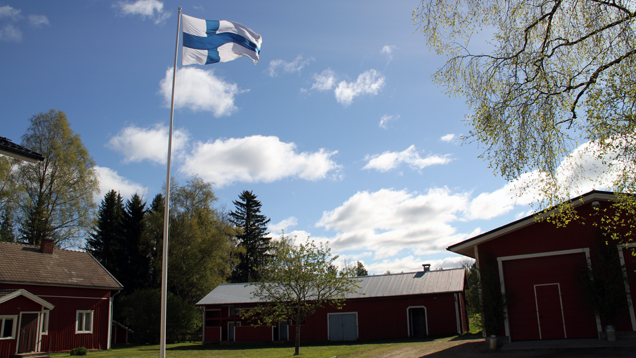
Ministry of the Interior
Publication date 23.5.2018 9.11 | Published in English on 28.5.2018 at 14.15
Type:News item

The history of the Finnish flag is an expedition into our Finnish identity and our national mindscape. One hundred years ago, the fight for our own flag had to do with the past and our right to define the essence of Finnish identity. After a long and multifaceted debate, the blue and white colours were chosen to symbolise the national identity of Finland.

The national colours of most countries are of heraldic origin. The basic rule of heraldry, or the study of coats of arms, demands that at least two colours, a dark and a light, must be used. This provides good contrast and makes the flag visible from a distance. The Finnish flag question turned into a huge dispute over colours. The colour blue had its roots in history, but the flag with a lion on a red field and the red flag featuring a yellow cross gained support particularly among Swedish-speaking members of parliament.

Debate started as early as in 1848

The debate about the Finnish flag and its colours lasted for decades. The flag of the Helsinki University Student Union depicting the coat of arms of the autonomous Grand Duchy of Finland on a white field was displayed at a student spring festival in Toukola, Helsinki, in 1848. Following this event, a lively debate about the Finnish flag ensued, especially thanks to Zachris Topelius, and during the following decades, several proposals for a Finnish flag were made.

The debate continued throughout the 1850s and 1860s, and blue and white gained support as national colours. However, the Finnish Diet never took up the matter, and the debate about different proposals was limited to newspapers, the media of the time. Nevertheless, Finns used many of the proposed flag designs at their country homes in the late 19th century, and gradually blue and white were adopted, for example, by yacht clubs for their flags and pennants.

Dispute over colours

Finland declared independence on 6 December 1917. The occasion was celebrated by flying the red-and-yellow lion flag from the Government Palace the same day. During the first months of independence in 1917–1918, it was also used as the semi-official state flag. The flag had a crimson-and-vermilion-coloured field displaying the lion depicted in the arms of Finland, the golden animal armed in silver and surrounded by rosettes of the same colour.

However, the outbreak of the Civil War in January 1918 postponed the debate. When the Civil War ended in May 1918, the red-field flag no longer seemed that appealing to the nation, or at least to those who won the War. The Civil War ended with the victory of the Whites, who celebrated the end of the War with a parade in Helsinki.

Symbolically, red has been a colour of contrasts for years. Red — symbolising the fight between good and evil, victory and blood, life and death — was later also seen in the flags of revolution, first in France and then in Russia.

One united nation

Once peace was declared, the non-socialists were unsure about the colour red. The association with the Red Guard was too strong. Working-class people on the other hand saw the red-and-yellow coat of arms displaying a lion holding a sword as a symbol of the tyranny of the estates. Many of the supporters of red and yellow, which were used in the coat of arms, started to support the white-and-blue flag.

Parliament wanted to reach a quick decision on the Finnish flag. The proposal of Parliament’s Constitutional Law Committee for a white flag with a blue cross did not inspire artist and lieutenant Akseli Gallen-Kallela, who led the the Military Uniform Committee Drawing Office. While the master himself was enjoying the beauty of the countryside, artist Eero Snellman, who worked at the General Staff Drawing Office, finalised the flag design together with artist Bruno Tuukkanen and submitted the design to the Constitutional Law Committee for consideration.

In the new design, the marine blue cross was wider and the blue colour was darker. The red-and-yellow lion coat of arms was placed in the centre of the flag. After a compromise was reached on the colours, the new national symbol was ready. The white flag with a blue cross became the national flag. The red-and-yellow coat of arms placed in the middle of the cross is still featured in the state flag, the flag of the President of the Republic and the flag of the Defence Forces as a reminder of the old flag design.

The relevant report of the Constitutional Law Committee was adopted unanimously by Parliament on 28 May 1918. The bill on the Finnish flag was approved the following day when the whole Senate approved and signed the bill enacted by Parliament. Only small changes have been made to the Act on the Flag of Finland since then. The flag, however, has remained the same. The 100th anniversary of the Finnish flag is celebrated now in May 2018.

Finnish flag belongs to us all

The traditions of the Finnish flag flying culture are very young and few in number by pan-European standards. There is also a lot of cautiousness connected to flying the flag and celebrating independence. Finns respect the flag deeply and are somewhat nervous about hoisting the flag. People sometimes wonder if they dare to fly the flag or how the flag should be folded correctly.

There is no need to be nervous. Flying the flag is easy but the flag should be treated with respect. Finland is worth celebrating, and there is no better way of doing this than hoisting the Finnish flag on its 100th anniversary.

The book Siniristilippumme (‘Our blue-crossed flag’) by Caius Kajanti was used as a source for this article.

For more information, please contact:

Hanne Huvila, Senior Specialist, tel. +358 295 488 313, [email protected]

Finnish identity communication flag of Finland flagging history

MINISTRY OF THE INTERIOR
Sisäministeriö | Inrikesministeriet

Kirkkokatu 12, Helsinki
PO Box 26, FI-00023 Government
Tel. 0295 480 171 (switchboard)
[email protected]

About the site
Accessibility statement
Data protection
Sitemap
Questions and feedback

X (Twitter)
Instagram
LinkedIn
Facebook
YouTube

Search page
  • Frontpage
  • Areas of expertise
    • Police
      • Government Programme measures in the police sector
      • Crime in Finland
      • Organised crime
        • Fight against organised crime
      • Counter-terrorism
        • Counter-terrorism measures in Finland
      • Violent radicalisation
        • Action plan monitoring
      • Hate crime
        • Online targeting and shaming
      • Human trafficking
      • Economic crime and the shadow economy
      • Cybercrime
        • Tackling cybercrime
      • Firearms
        • Firearms legislation
      • Gambling
      • Fundraising
      • Public order and security
      • Private security sector
      • Agencies and responsibilities
    • Rescue services
      • Government Programme measures in rescue services
      • Rescue operations
        • Maritime search and rescue
        • Emergency warnings
      • Accident prevention
        • Chimney sweeping
        • Smoke alarms and other fire safety equipment
          • Smoke alarm
          • Responsibility for smoke alarms to change in 2026
          • Carbon monoxide and heat detectors
          • First-aid extinguishing equipment
          • Fire safety systems of buildings
          • Systems connected to the ERC
          • Supervision of fire safety equipment
          • Frequently asked questions about smoke alarms
        • Emergency plan
        • Fire safety
      • Preparedness
        • National risk assessment
        • Civil defence
        • Civil defence shelters
        • Preparedness guide
      • International assistance
        • International cooperation in civil preparedness
        • Civil Protection Mechanism
      • National objectives for wellbeing services counties
      • Rescue service agencies and responsibilities
    • Emergency response
      • Emergency response centres
      • Services
    • Border management
      • Government Programme measures to reform border security
      • Border surveillance
      • Maritime search and rescue
      • Fight against environmental damage in sea areas
      • Smart Borders
      • Frontex cooperation
      • Agencies and responsibilities
    • Migration
      • Government Programme measures to reform migration policy
        • Stricter conditions for permanent residence permits
      • Agencies and responsibilities
        • Preparing for large-scale influxes of migrants
      • Migration and asylum policy
        • Family reunification
      • Refugees and asylum seekers
        • Quota refugees
      • EU migration and asylum system
      • Removal and departure from the country
        • Voluntary and forced return
        • Readmission agreements
      • Nationality
        • Preconditions for and effects of acquiring Finnish citizenship
        • Expatriate Finns
      • Combating irregular entry and stay
    • National security
      • Government Programme measures to reform national security
      • What is national security?
        • Critical Infrastructure Protection and Crisis Resilience Act
      • Civilian intelligence
        • Questions and answers about civilian intelligence legislation
      • Hybrid threats
      • Cyber security
    • Civilian crisis management
      • Finland's objectives
      • Finnish experts serving in operations
      • Recruitment and training
      • Agencies and responsibilities
      • Legislation
    • Flag and arms of Finland
      • Flag days
        • Flagdays 2025
        • Proposals for flag days
      • Flying the flag at half mast
      • Flying the EU flag
      • Order of precedence
      • About the flag
        • History of the flag
      • Arms of Finland
      • The flag and coat of arms in commercial activities
  • Current issues
    • News
      • News archive
    • Sign up for news
    • Ukraine
      • Civilian material assistance to Ukraine
        • Laptops for Ukraine
        • Civilian assistance sent from Finland
      • Helping Ukrainians
      • Temporary protection
      • Frequently asked questions
    • Situation at the eastern border
  • Projects and legislation
    • Reform of legislation on civilian intelligence
    • Passport project
    • Strengthening crime prevention
      • Answers to questions about biometric data regulation
    • Reform of the gambling system
      • Questions and answers on gambling system reform
    • Shooting ranges project
    • Reform of the Citizenship Act
      • Frequently asked questions
    • Interoperability of data within EU information systems for security
    • Secure satellite communication services
  • Publications
  • Ministry
    • Tasks and objectives
    • Management and organisation
      • Minister of the Interior
      • Permanent Secretary
      • Departments and units
    • Branch of government
    • Joint strategy for the Ministry's administrative branch
    • Operations and finances
    • Government Report on Internal Security
    • International and EU cooperation
      • Sub-committees on EU affairs
      • Finland and Nato
    • Oversight of legality
      • Oversight of legality at agencies within the Ministry’s branch of government
    • Research
      • Sentimentti data tool
      • Strategic foresight
    • Funds
    • Ministry as workplace
      • Personnel
      • Responsibility
      • Ministry’s pay system
      • Applying for a job
      • Traineeships
    • Whistleblower protection
    • History of the ministry
  • Contact
    • Submissions for consideration
    • Request for information
    • Contact information of the management, departments and units
    • Communications Unit
    • Data protection
      • Information on cookies
    • Accessibility statement
    • Feedback