
Skip to content
  • Finnish Government
    • Prime Minister's Office
    • Ministry of Defence
    • Ministry of Transport and Communications
    • Ministry for Foreign Affairs
    • Ministry of Finance
    • Ministry of Economic Affairs and Employment
    • Ministry of Justice
    • Ministry of Education and Culture
    • Ministry of Social Affairs and Health
    • Ministry of the Interior
    • Ministry of Agriculture and Forestry
    • Ministry of the Environment

Valitse kieli:

This page is in Finnish. Go to the English site »

Or choose language:

Den här sidan är på finska. Gå till den svenska versionen av sidan »

Eller välj språk:

Dát siidu lea suomagillii. Sirdás davvisámegielat siidduide »

Dahje vállje giela:

Язык этого сайта финский. Перейти на русскоязычный сайт »

Или выберите язык:

Cette page est en finnois. Aller sur le site en français »

Ou choisir la langue:

Diese Seite ist auf Finnisch. Wechseln Sie zur deutschen Version »

Oder wählen Sie Ihre Sprache:

Tämä sivu on englanniksi. Siirry suomenkieliseen sivustoon »

Tai valitse kieli:

Choose language:

Den här sidan är på engelska. Gå till den svenska versionen av sidan »

Eller välj språk:

Язык этого сайта английский. Перейти на русскоязычный сайт »

Или выберите язык:

Dát siidu lea eŋgelasgillii. Sirdás davvisámegielat siidduide »

Dahje vállje giela:

Cette page est en anglais. Aller sur le site en français »

Ou choisir la langue:

Diese Seite ist auf Englisch. Wechseln Sie zur deutschen Version »

Oder wählen Sie Ihre Sprache:

Tämä sivu on ruotsiksi. Siirry suomenkieliseen sivustoon »

Tai valitse kieli:

This page is in Swedish. Go to the English site »

Or choose language:

Välj språk:

Язык этого сайта шведский. Перейти на русскоязычный сайт »

Или выберите язык:

Dát siidu lea eŋgelasgillii. Sirdás davvisámegielat siidduide »

Dahje vállje giela:

Cette page est en suédois. Aller sur le site en français »

Ou choisir la langue:

Diese Seite ist auf Schwedisch. Wechseln Sie zur deutschen Version »

Oder wählen Sie Ihre Sprache:

Tämä sivu on pohjois-saameksi. Siirry suomenkieliseen sivustoon »

Tai valitse kieli:

This page is in North Saami. Go to the English site »

Or choose language:

Den här sidan är på nordsamiska. Gå till den svenska versionen av sidan »

Eller välj språk:

Язык этого сайта северосаамский. Перейти на русскоязычный сайт »

Или выберите язык:

Vállje giela:

Cette page est en same du Nord. Aller sur le site en français »

Ou choisir la langue:

Diese Seite ist auf Nordsamisch. Wechseln Sie zur deutschen Version »

Oder wählen Sie Ihre Sprache:

Tämä sivu on venäjäksi. Siirry suomenkieliseen sivustoon »

Tai valitse kieli:

This page is in Russian. Go to the English site »

Or choose language:

Den här sidan är på ryska. Gå till den svenska versionen av sidan »

Eller välj språk:

Dát siidu lea ruoššagillii. Sirdás davvisámegielat siidduide »

Dahje vállje giela:

выберите язык:

Cette page est en russe. Aller sur le site en français »

Ou choisir la langue:

Diese Seite ist auf Russisch. Wechseln Sie zur deutschen Version »

Oder wählen Sie Ihre Sprache:

Tämä sivu on ranskaksi. Siirry suomenkieliseen sivustoon »

Tai valitse kieli:

This page is in French. Go to the English site »

Or choose language:

Den här sidan är på franska. Gå till den svenska versionen av sidan »

Eller välj språk:

Dát siidu lea fránskkagillii. Sirdás davvisámegielat siidduide »

Dahje vállje giela:

Язык этого сайта французский. Перейти на русскоязычный сайт »

Или выберите язык:

Choisir la langue:

Diese Seite ist auf Französisch. Wechseln Sie zur deutschen Version »

Oder wählen Sie Ihre Sprache:

Tämä sivu on saksaksi. Siirry suomenkieliseen sivustoon »

Tai valitse kieli:

This page is in German. Go to the English site »

Or choose language:

Den här sidan är på tyska. Gå till den svenska versionen av sidan »

Eller välj språk:

Язык этого сайта немецкий. Перейти на русскоязычный сайт »

Или выберите язык:

Cette page est en allemand. Aller sur le site en français »

Ou choisir la langue:

Wählen Sie Ihre Sprache:

  • Valitse kieli Suomi
  • Välj språket Svenska
  • Select language English
Media
Go to Sisäministeriö site frontpage
  • Frontpage
  • Areas of expertise
    • Police
    • Rescue services
    • Emergency response
    • Border management
    • Migration
    • National security
    • Civilian crisis management
    • Flag and arms of Finland
  • Current issues
  • Projects and legislation
  • Publications
  • Ministry
  • Contact
  • News
  • Sign up for news
  • Ukraine
  • Situation at the eastern border
suomiLue artikkeli suomeksi svenskaLäs artikeln på svenska English

Promoting equality is an essential part of civilian crisis management for Finland

Ministry of the Interior
Publication date 4.5.2018 7.00 | Published in English on 9.5.2018 at 8.51
Type:News item
Kuva: Kari Kumpulainen

Finland is known around the world as a country with strong expertise in crisis management. Nearly half of the Finnish civilian crisis management experts come from the Ministry of the Interior’s branch of government. The strength of Finnish crisis management is the work done to promote the equality and the integrated approach, in other words cooperation between different parties in stabilising conflict-affected countries.

South Sudan is the world’s newest state, whose short history is characterised by civil war, violence and poverty. Half of the population in the country, which became independent in 2011, live in refugee camps around the country or in nearby states. The unstable situation in this fragile country is reflected in the increase in political violence, crime and human smuggling.

"So far the Crisis Management Centre (CMC Finland) has seconded a total of 13 civilian crisis management experts to the United Nations Mission in South Sudan (UNMISS). The mandate of the UNMISS mission is to support this new state in peacebuilding and statebuilding, report on human rights following the civil war that erupted in 2013, and protect civilians," says Tiina Ehrnrooth, Senior Specialist at the Finnish Ministry of the Interior.

Finland leads the way in crisis management

In relation to its population, Finland is a world leader in crisis management. Over the years, a total of 549 Finnish people have participated in missions led, for example, by the EU, the OSCE, the UN or the coalition against ISIS. At the moment, nearly 40 per cent of the Finnish civilian crisis management experts are women. The corresponding figure in other European countries is about 20 per cent.

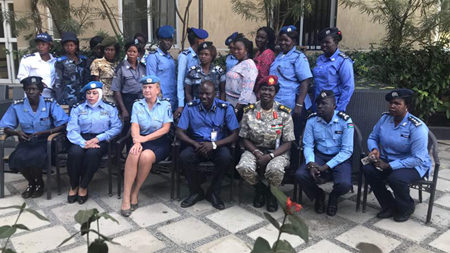
Finland is also a leader in combating violence and sexual crime against women and children in crisis areas. In early 2017, Finland sent a group of police officers to South Sudan, with the aim of introducing practices that promote gender equality. The group’s task is also to take forward the idea of empowering women and female police officers.

"Team thinking specialised in this kind of theme is new in UN peacekeeping missions. Thanks to the group’s efforts, five local police officers from South Sudan who do similar work as their Finnish colleagues will take part in a study visit to Finland next September," says Ehrnrooth.

The whole is greater than the sum of its parts
In addition to promoting the integrated approach, Finland aims to take account of the connection between internal and external security as part of the work carried out in conflict-affected countries. This includes improving cooperation between the EU’s crisis management and development activities as well as the authorities responsible for the EU’s internal security. Efforts are also made to create new kinds of networks for those involved in crisis management work in Finland.

"The Crisis Management Centre operating under the Ministry of the Interior, the Finnish Defence Forces International Centre FINCENT and the Police University College have joined forces in a project called the Finnish Centre of Expertise in Comprehensive Crisis Management in order to enhance their mutual cooperation and networking. The project will run until September 2018. The aim is to introduce new concrete practices which would bring genuine added value to all parties through the integrated approach and cooperation," says Ehrnrooth.

Civilian crisis management is work carried out within the framework of international organisations which aims to reduce instability in different conflict-ridden countries and to prevent chaotic conditions from spreading any further. Civilian crisis management could, in fact, be described as a bridge between security and development work, aiming to achieve sustainable peace and stability in society. The stabilisation of conflict-affected countries also helps to reduce uncontrolled migration and the spread of crime and terrorism. Therefore, effective civilian crisis management abroad also contributes to security in Finland.

New commitments to EU countries

This year the Council is taking active steps to further develop the EU’s civilian crisis management work, and we can expect to see the introduction of new policy guidelines in late 2018. At EU level, efforts are made to guide civilian crisis management activities in a way that Member States would be bound by certain quotas for seconding experts abroad. This change will also set new requirements for Finland’s national capability.

"The problem with the EU’s civilian crisis management operations is that Member States do not second enough experts and therefore some of the positions remain unfilled. The idea behind the new model is that the European External Action Service, the Commission and the Member States would agree on concrete commitments to cover the shortage of resources," explains Ehrnrooth.

Finland aims to second experts to leading positions

Kauko Aaltomaa, who has previously worked as Director General of the Ministry of the Interior's Police Department, currently leads the EU civilian crisis management mission in the Palestinian territories. The EU Police Mission for the Palestinian Territories, EUPOL COPPS, supports the Palestinian Authority, judicial system and police in building institutions that are in line with the international standards and the principles of the rule of law.
No matter how strong a candidate is, his or her appointment to a leading position in civilian crisis management can never be taken for granted. What is needed in addition to background work is successful lobbying. The candidate’s competence is not the only factor that affects the final decision; the balance between the Member States in the ongoing operations also plays a role in all this. Many large Member States, such as Germany or France, also exert a lot of influence in such decisions.

Finland has been successful in getting leading positions within the EU and the OSCE, despite its small size. It has simultaneously held as many as four top-level positions out of the total about twenty missions. According to Ehrnrooth, Finland’s next goal is to get a position in a UN mission that would be equivalent to the level of police commissioner.

"We still have to work on this. A lot depends on how well we are able to attract police officers making a career in Finland to apply for these positions. Aaltomaa is an excellent example of this, and we hope to see more such applicants," says Ehrnrooth, who is responsible for recruiting Finnish civilian crisis management experts for top-level duties.

Minna Hulkkonen, Ministerial Adviser, and Vesa Kotilainen, Senior Specialist, also work in the Ministry of the Interior’s International Affairs Unit, dealing with civilian crisis management matters. Antti Häikiö, who is currently on leave of absence from his post as ministerial adviser, works as a seconded national expert dealing with civilian crisis management issues at the European External Action Service in Brussels.

If you wish to receive information on vacant positions by email, please subscribe to the newsletter of CMC Finland by joining the distribution list.

For more information: Finnish experts serving in operations


Inquiries:

Tiina Ehrnrooth, Senior Specialist, tel. +358 295 488 277, [email protected]

Kauko Aaltomaa, Head of EUPOL COPPS Mission, [email protected]

civilian crisis management comprehensiveness equality internal properties

MINISTRY OF THE INTERIOR
Sisäministeriö | Inrikesministeriet

Kirkkokatu 12, Helsinki
PO Box 26, FI-00023 Government
Tel. 0295 480 171 (switchboard)
[email protected]

About the site
Accessibility statement
Data protection
Sitemap
Questions and feedback

X (Twitter)
Instagram
LinkedIn
Facebook
YouTube

Search page
  • Frontpage
  • Areas of expertise
    • Police
      • Government Programme measures in the police sector
      • Crime in Finland
      • Organised crime
        • Fight against organised crime
      • Counter-terrorism
        • Counter-terrorism measures in Finland
      • Violent radicalisation
      • Hate crime
        • Online targeting and shaming
      • Human trafficking
      • Economic crime and the shadow economy
      • Cybercrime
        • Tackling cybercrime
      • Firearms
        • Firearms legislation
      • Gambling
      • Fundraising
      • Public order and security
      • Private security sector
      • Agencies and responsibilities
    • Rescue services
      • Government Programme measures in rescue services
      • Rescue operations
        • Maritime search and rescue
        • Emergency warnings
      • Accident prevention
        • Chimney sweeping
        • Smoke alarms and other fire safety equipment
          • Smoke alarm
          • Responsibility for smoke alarms to change in 2026
          • Carbon monoxide and heat detectors
          • First-aid extinguishing equipment
          • Fire safety systems of buildings
          • Systems connected to the ERC
          • Supervision of fire safety equipment
          • Frequently asked questions about smoke alarms
        • Emergency plan
        • Fire safety
      • Preparedness
        • National risk assessment
        • Civil defence
        • Civil defence shelters
        • Preparedness guide
      • International assistance
        • International cooperation in civil preparedness
        • Civil Protection Mechanism
      • National objectives for wellbeing services counties
      • Rescue service agencies and responsibilities
    • Emergency response
      • Emergency response centres
      • Services
    • Border management
      • Government Programme measures to reform border security
      • Border surveillance
      • Maritime search and rescue
      • Fight against environmental damage in sea areas
      • Smart Borders
      • Frontex cooperation
      • Agencies and responsibilities
    • Migration
      • Government Programme measures to reform migration policy
        • Stricter conditions for permanent residence permits
      • Agencies and responsibilities
        • Preparing for large-scale influxes of migrants
      • Migration and asylum policy
        • Family reunification
      • Refugees and asylum seekers
        • Quota refugees
      • EU migration and asylum system
      • Removal and departure from the country
        • Voluntary and forced return
        • Readmission agreements
      • Nationality
        • Preconditions for and effects of acquiring Finnish citizenship
        • Expatriate Finns
      • Combating irregular entry and stay
    • National security
      • Government Programme measures to reform national security
      • What is national security?
        • Critical Infrastructure Protection and Crisis Resilience Act
      • Civilian intelligence
        • Questions and answers about civilian intelligence legislation
      • Hybrid threats
      • Cyber security
    • Civilian crisis management
      • Finland's objectives
      • Finnish experts serving in operations
      • Recruitment and training
      • Agencies and responsibilities
      • Legislation
    • Flag and arms of Finland
      • Flag days
        • Flag days 2026
        • Flagdays 2025
        • Proposals for flag days
      • Flying the flag at half mast
      • Flying the EU flag
      • Order of precedence
      • About the flag
        • History of the flag
      • Arms of Finland
      • The flag and coat of arms in commercial activities
  • Current issues
    • News
      • News archive
    • Sign up for news
    • Ukraine
      • Civilian material assistance to Ukraine
        • Laptops for Ukraine
        • Civilian assistance sent from Finland
      • Helping Ukrainians
      • Temporary protection
      • Frequently asked questions
    • Situation at the eastern border
  • Projects and legislation
    • Reform of legislation on civilian intelligence
    • Passport project
    • Strengthening crime prevention
      • Answers to questions about biometric data regulation
    • Reform of the gambling system
      • Questions and answers on gambling system reform
    • Shooting ranges project
    • Reform of the Citizenship Act
      • Frequently asked questions
    • Interoperability of data within EU information systems for security
    • Secure satellite communication services
  • Publications
  • Ministry
    • Tasks and objectives
    • Management and organisation
      • Minister of the Interior
      • Permanent Secretary
      • Departments and units
    • Branch of government
    • Joint strategy for the Ministry's administrative branch
    • Operations and finances
    • Government Report on Internal Security
    • International and EU cooperation
      • Sub-committees on EU affairs
      • Finland and Nato
    • Oversight of legality
      • Oversight of legality at agencies within the Ministry’s branch of government
    • Research
      • Sentimentti data tool
      • Strategic foresight
    • Funds
    • Ministry as workplace
      • Personnel
      • Responsibility
      • Ministry’s pay system
      • Applying for a job
      • Traineeships
    • Whistleblower protection
    • History of the ministry
  • Contact
    • Submissions for consideration
    • Request for information
    • Contact information of the management, departments and units
    • Communications Unit
    • Data protection
      • Information on cookies
    • Accessibility statement
    • Feedback