
Skip to content
  • Finnish Government
    • Prime Minister's Office
    • Ministry of Defence
    • Ministry of Transport and Communications
    • Ministry for Foreign Affairs
    • Ministry of Finance
    • Ministry of Economic Affairs and Employment
    • Ministry of Justice
    • Ministry of Education and Culture
    • Ministry of Social Affairs and Health
    • Ministry of the Interior
    • Ministry of Agriculture and Forestry
    • Ministry of the Environment

Valitse kieli:

This page is in Finnish. Go to the English site »

Or choose language:

Den här sidan är på finska. Gå till den svenska versionen av sidan »

Eller välj språk:

Dát siidu lea suomagillii. Sirdás davvisámegielat siidduide »

Dahje vállje giela:

Язык этого сайта финский. Перейти на русскоязычный сайт »

Или выберите язык:

Cette page est en finnois. Aller sur le site en français »

Ou choisir la langue:

Diese Seite ist auf Finnisch. Wechseln Sie zur deutschen Version »

Oder wählen Sie Ihre Sprache:

Tämä sivu on englanniksi. Siirry suomenkieliseen sivustoon »

Tai valitse kieli:

Choose language:

Den här sidan är på engelska. Gå till den svenska versionen av sidan »

Eller välj språk:

Язык этого сайта английский. Перейти на русскоязычный сайт »

Или выберите язык:

Dát siidu lea eŋgelasgillii. Sirdás davvisámegielat siidduide »

Dahje vállje giela:

Cette page est en anglais. Aller sur le site en français »

Ou choisir la langue:

Diese Seite ist auf Englisch. Wechseln Sie zur deutschen Version »

Oder wählen Sie Ihre Sprache:

Tämä sivu on ruotsiksi. Siirry suomenkieliseen sivustoon »

Tai valitse kieli:

This page is in Swedish. Go to the English site »

Or choose language:

Välj språk:

Язык этого сайта шведский. Перейти на русскоязычный сайт »

Или выберите язык:

Dát siidu lea eŋgelasgillii. Sirdás davvisámegielat siidduide »

Dahje vállje giela:

Cette page est en suédois. Aller sur le site en français »

Ou choisir la langue:

Diese Seite ist auf Schwedisch. Wechseln Sie zur deutschen Version »

Oder wählen Sie Ihre Sprache:

Tämä sivu on pohjois-saameksi. Siirry suomenkieliseen sivustoon »

Tai valitse kieli:

This page is in North Saami. Go to the English site »

Or choose language:

Den här sidan är på nordsamiska. Gå till den svenska versionen av sidan »

Eller välj språk:

Язык этого сайта северосаамский. Перейти на русскоязычный сайт »

Или выберите язык:

Vállje giela:

Cette page est en same du Nord. Aller sur le site en français »

Ou choisir la langue:

Diese Seite ist auf Nordsamisch. Wechseln Sie zur deutschen Version »

Oder wählen Sie Ihre Sprache:

Tämä sivu on venäjäksi. Siirry suomenkieliseen sivustoon »

Tai valitse kieli:

This page is in Russian. Go to the English site »

Or choose language:

Den här sidan är på ryska. Gå till den svenska versionen av sidan »

Eller välj språk:

Dát siidu lea ruoššagillii. Sirdás davvisámegielat siidduide »

Dahje vállje giela:

выберите язык:

Cette page est en russe. Aller sur le site en français »

Ou choisir la langue:

Diese Seite ist auf Russisch. Wechseln Sie zur deutschen Version »

Oder wählen Sie Ihre Sprache:

Tämä sivu on ranskaksi. Siirry suomenkieliseen sivustoon »

Tai valitse kieli:

This page is in French. Go to the English site »

Or choose language:

Den här sidan är på franska. Gå till den svenska versionen av sidan »

Eller välj språk:

Dát siidu lea fránskkagillii. Sirdás davvisámegielat siidduide »

Dahje vállje giela:

Язык этого сайта французский. Перейти на русскоязычный сайт »

Или выберите язык:

Choisir la langue:

Diese Seite ist auf Französisch. Wechseln Sie zur deutschen Version »

Oder wählen Sie Ihre Sprache:

Tämä sivu on saksaksi. Siirry suomenkieliseen sivustoon »

Tai valitse kieli:

This page is in German. Go to the English site »

Or choose language:

Den här sidan är på tyska. Gå till den svenska versionen av sidan »

Eller välj språk:

Язык этого сайта немецкий. Перейти на русскоязычный сайт »

Или выберите язык:

Cette page est en allemand. Aller sur le site en français »

Ou choisir la langue:

Wählen Sie Ihre Sprache:

  • Valitse kieli Suomi
  • Välj språket Svenska
  • Select language English
Media
Go to Sisäministeriö site frontpage
  • Frontpage
  • Areas of expertise
    • Police
    • Rescue services
    • Emergency response
    • Border management
    • Migration
    • National security
    • Civilian crisis management
    • Flag and arms of Finland
  • Current issues
  • Projects and legislation
  • Publications
  • Ministry
  • Contact
  • News
  • Sign up for news
  • Ukraine
  • Situation at the eastern border
suomiLue artikkeli suomeksi svenskaLäs artikeln på svenska English

Crisis management at the centre of world politics
Ministry of the Interior
Publication date 19.6.2018 9.20
Type:News item
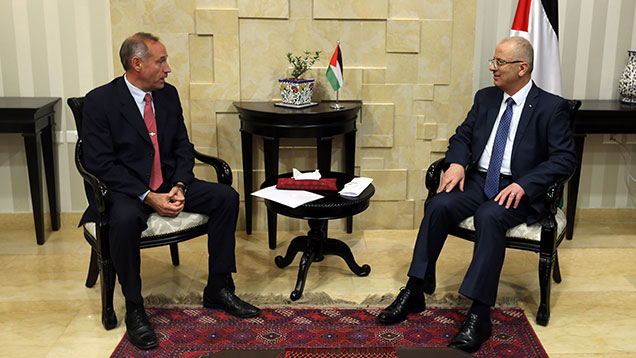
Kauko Aaltomaa met Dr. Rami Hamdallah, Palestinian Prime Minister, in April 2018. During their meeting, they discussed the work of the mission.

The conflict between Palestine and Israel has continued for 70 years. The EUPOL COPPS civilian crisis management mission works to put to rest the long-lasting crisis and achieve basic security in the region. The Palestinian question was created by people, and people can also resolve it.

Ramallah is the unofficial Palestinian capital and a place where religions and cultures meet. It also houses the headquarters of the EUPOL COPPS civilian crisis management mission. The head of the mission is Kauko Aaltomaa, who is on leave of absence from his post as Director General of the Ministry of the Interior's Police Department. He monitors the situation in the West Bank first hand from his office in Ramallah.

"Our duty is to advise, train and mentor the local authorities, although in the end it is for the Palestinian Authority to decide which decisions they will make and which goals they will set for themselves. Their decisions and goals, if any, are connected with the prevailing local politics," Aaltomaa points out.

The EUPOL COPPS mission works to address the needs of the Palestinian Authority and to build governmental structures. Its goal is to develop the civil sector of the Palestinian Authority by providing extensive advice and training to the security and judicial authorities. The mandate uses several operating principles. One of them is to increase cooperation between the Palestinian and Israeli security apparatus.

Why is there so much anger in the Middle East?

Israel became an independent state on 14 May 1948 which, combined with the resulting controversial emotions, is considered to mark the beginning of the current conflict in the Middle East. Behind the dispute is the idea of two independent states. The two-state model, which includes the foundation of an independent Palestinian state, is also the basis of the EU mission. In fact, the current conflict in the Middle East culminates in the question of which of the conflict parties has a greater right to the region: the Jews or the Palestinians.

The cultural environment must be taken into consideration in all operations. The West Bank area is the scene of world politics and relations between the great powers. The controversies have deep historical roots. The shadows of colonialism in the Middle East, which resulted from the European power politics and the post-war superpower politics, have not disappeared.

A mosaic of several players

The tensions in the region are very similar to those 30 years ago, when Aaltomaa was engaged in UN peacekeeping and military observer missions. However, the surrounding world has changed. The resource-rich region has a strategic role. It is the scene of high-level world politics and rivalry between the great powers and regional players, so the situation can change quickly. The points of interest and objectives of different countries are intertwined.

"The areas inhabited by the Palestinians are at the heart of the relations between the great powers. Although the world political situation does not directly affect our mission, the political interests and actions of the Palestinians have a direct impact on it," Aaltomaa says.

In the day-to-day work of the civilian crisis management mission, the determined stand of Israel shows, among other things, in the fact that the mission’s employees do not live in Ramallah but rather in Jerusalem, where they return every night after their working day.

Advice and state-building

The EU has already been looking for a peaceful solution to the conflict-prone situation in the Middle East for two decades. It has been difficult to achieve any results. The EUPOL COPPS mission, which was launched in 2006, focuses on supporting the Palestinian Authority and providing technical advice and assistance in building a Palestinian state. The mandate is not political but technical. This means that the mission does not represent any political stand or view.

When Aaltomaa started his work as the head of the civilian crisis management mission six months ago, the mission was in a difficult situation.

"It takes a lot of time to proceed with matters and achieve lasting results. You must be confident that one day the long, persistent state-building efforts will bear fruit. The unstable situation in this part of the world has continued for a long time and somehow you simply have to accept it," Aaltomaa says.

Persistent work towards a common goal

Families and relatives are important in the Middle East. In Israel’s opinion, the Palestinian autonomy may be apparent or limited in many respects. In addition, legislative obstacles may hamper the implementation of the mission.

There are a wealth of players in the West Bank, so cooperation has to be pursued with a mixed group of people. The framework of the mission consists of the Palestinian Authority, organisations, representatives of different countries and the EU structures set in Brussels. According to Aaltomaa, successful cooperation between different players largely determines how well the mission will achieve its goal.

"My focus is on contacts with the local decision-makers and opinion leaders. The work perspective is from the mission towards different partners. It is the duty of the deputy chief to look more after arrangements within the mission and act as a chief of staff," Aaltomaa says about the division of duties in running the mission.

Common sense and knowledge of the environment

The local people consider Aaltomaa a gentleman leader with a calm attitude. According to Aaltomaa, running the mission in the West Bank is similar to anywhere else, although the tense conditions in the Middle East add a special element in the work. There are also major cultural and religious differences in the region and within the mission.

"It is very important that you can interpret and understand people. As I see it, showing Finnish common sense is very effective here, too. If you have patience to listen to people, take them into consideration as human beings, and act systematically and with a determined attitude, you will succeed quite well," says Aaltomaa, who has worked his way from a police officer through administrative positions.

Comprehensiveness at the core of operations

Crisis management covers all the sections of society. For example, the mandate of the EUPOL COPPS mission in the West Bank is very broad. In addition to the security sector, the mission works closely with the judicial administration authorities. This involves further developing the practice of legal professions.

In crisis management, you must be able to play in many fields at the same time. A comprehensive approach to crisis management is also an important priority for the EU.

"It is not enough to operate efficiently in a specific area of society when you are trying to improve the situation of several crises. It is especially important that different professionals and players work towards the same goal. Trying to build security by only improving the police is not enough. Management must take place broadly within society," Aaltomaa points out.

More information:
Head of EUPOL COPPS Mission Kauko Aaltomaa, [email protected]

EUROL COPPS in a nutshell

  • Police Mission for the Palestinian Territories
  • Operates under the European Union’s mandate
  • The main focus is on training the Palestinian police, further developing the criminal justice system and enhancing the police-prosecutor cooperation.
  • The aim is to support the Palestinian Authority to build efficiently functioning institutions in line with international standards.
  • A total of 70 experts from different European countries and Canada are employed in the mission.
  • Eight of these experts are Finns, representing different administrative branches.
  • The current mandate will end in the summer, although it is likely to continue.
  • The civilian crisis management operations of the European Union are part of its common foreign and security policy: the work indirectly affects the internal security of the EU and Finland, such as border and migration management.
EU civilian crisis management confederations of states crisis management crisis management

MINISTRY OF THE INTERIOR
Sisäministeriö | Inrikesministeriet

Kirkkokatu 12, Helsinki
PO Box 26, FI-00023 Government
Tel. 0295 480 171 (switchboard)
[email protected]

About the site
Accessibility statement
Data protection
Sitemap
Questions and feedback

X (Twitter)
Instagram
LinkedIn
Facebook
YouTube

Search page
  • Frontpage
  • Areas of expertise
    • Police
      • Government Programme measures in the police sector
      • Crime in Finland
      • Organised crime
        • Fight against organised crime
      • Counter-terrorism
        • Counter-terrorism measures in Finland
      • Violent radicalisation
        • Action plan monitoring
      • Hate crime
        • Online targeting and shaming
      • Human trafficking
      • Economic crime and the shadow economy
      • Cybercrime
        • Tackling cybercrime
      • Firearms
        • Firearms legislation
      • Gambling
      • Fundraising
      • Public order and security
      • Private security sector
      • Agencies and responsibilities
    • Rescue services
      • Government Programme measures in rescue services
      • Rescue operations
        • Maritime search and rescue
        • Emergency warnings
      • Accident prevention
        • Chimney sweeping
        • Smoke alarms and other fire safety equipment
          • Smoke alarm
          • Responsibility for smoke alarms to change in 2026
          • Carbon monoxide and heat detectors
          • First-aid extinguishing equipment
          • Fire safety systems of buildings
          • Systems connected to the ERC
          • Supervision of fire safety equipment
          • Frequently asked questions about smoke alarms
        • Emergency plan
        • Fire safety
      • Preparedness
        • National risk assessment
        • Civil defence
        • Civil defence shelters
        • Preparedness guide
      • International assistance
        • International cooperation in civil preparedness
        • Civil Protection Mechanism
      • National objectives for wellbeing services counties
      • Rescue service agencies and responsibilities
    • Emergency response
      • Emergency response centres
      • Services
    • Border management
      • Government Programme measures to reform border security
      • Border surveillance
      • Maritime search and rescue
      • Fight against environmental damage in sea areas
      • Smart Borders
      • Frontex cooperation
      • Agencies and responsibilities
    • Migration
      • Government Programme measures to reform migration policy
        • Stricter conditions for permanent residence permits
      • Agencies and responsibilities
        • Preparing for large-scale influxes of migrants
      • Migration and asylum policy
        • Family reunification
      • Refugees and asylum seekers
        • Quota refugees
      • EU migration and asylum system
      • Removal and departure from the country
        • Voluntary and forced return
        • Readmission agreements
      • Nationality
        • Preconditions for and effects of acquiring Finnish citizenship
        • Expatriate Finns
      • Combating irregular entry and stay
    • National security
      • Government Programme measures to reform national security
      • What is national security?
        • Critical Infrastructure Protection and Crisis Resilience Act
      • Civilian intelligence
        • Questions and answers about civilian intelligence legislation
      • Hybrid threats
      • Cyber security
    • Civilian crisis management
      • Finland's objectives
      • Finnish experts serving in operations
      • Recruitment and training
      • Agencies and responsibilities
      • Legislation
    • Flag and arms of Finland
      • Flag days
        • Flagdays 2025
        • Proposals for flag days
      • Flying the flag at half mast
      • Flying the EU flag
      • Order of precedence
      • About the flag
        • History of the flag
      • Arms of Finland
      • The flag and coat of arms in commercial activities
  • Current issues
    • News
      • News archive
    • Sign up for news
    • Ukraine
      • Civilian material assistance to Ukraine
        • Laptops for Ukraine
        • Civilian assistance sent from Finland
      • Helping Ukrainians
      • Temporary protection
      • Frequently asked questions
    • Situation at the eastern border
  • Projects and legislation
    • Reform of legislation on civilian intelligence
    • Passport project
    • Strengthening crime prevention
      • Answers to questions about biometric data regulation
    • Reform of the gambling system
      • Questions and answers on gambling system reform
    • Shooting ranges project
    • Reform of the Citizenship Act
      • Frequently asked questions
    • Interoperability of data within EU information systems for security
    • Secure satellite communication services
  • Publications
  • Ministry
    • Tasks and objectives
    • Management and organisation
      • Minister of the Interior
      • Permanent Secretary
      • Departments and units
    • Branch of government
    • Joint strategy for the Ministry's administrative branch
    • Operations and finances
    • Government Report on Internal Security
    • International and EU cooperation
      • Sub-committees on EU affairs
      • Finland and Nato
    • Oversight of legality
      • Oversight of legality at agencies within the Ministry’s branch of government
    • Research
      • Sentimentti data tool
      • Strategic foresight
    • Funds
    • Ministry as workplace
      • Personnel
      • Responsibility
      • Ministry’s pay system
      • Applying for a job
      • Traineeships
    • Whistleblower protection
    • History of the ministry
  • Contact
    • Submissions for consideration
    • Request for information
    • Contact information of the management, departments and units
    • Communications Unit
    • Data protection
      • Information on cookies
    • Accessibility statement
    • Feedback