
Hyppää sisältöön
  • Valtioneuvosto
    • Valtio­neuvoston kanslia
    • Puolustus­ministeriö
    • Liikenne- ja viestintä­ministeriö
    • Ulko­ministeriö
    • Valtio­varain­ministeriö
    • Työ- ja elinkeino­ministeriö
    • Oikeus­ministeriö
    • Opetus- ja kulttuuri­ministeriö
    • Sosiaali- ja terveys­ministeriö
    • Sisä­ministeriö
    • Maa- ja metsätalous­ministeriö
    • Ympäristö­ministeriö

Valitse kieli:

This page is in Finnish. Go to the English site »

Or choose language:

Den här sidan är på finska. Gå till den svenska versionen av sidan »

Eller välj språk:

Dát siidu lea suomagillii. Sirdás davvisámegielat siidduide »

Dahje vállje giela:

Язык этого сайта финский. Перейти на русскоязычный сайт »

Или выберите язык:

Cette page est en finnois. Aller sur le site en français »

Ou choisir la langue:

Diese Seite ist auf Finnisch. Wechseln Sie zur deutschen Version »

Oder wählen Sie Ihre Sprache:

Tämä sivu on englanniksi. Siirry suomenkieliseen sivustoon »

Tai valitse kieli:

Choose language:

Den här sidan är på engelska. Gå till den svenska versionen av sidan »

Eller välj språk:

Язык этого сайта английский. Перейти на русскоязычный сайт »

Или выберите язык:

Dát siidu lea eŋgelasgillii. Sirdás davvisámegielat siidduide »

Dahje vállje giela:

Cette page est en anglais. Aller sur le site en français »

Ou choisir la langue:

Diese Seite ist auf Englisch. Wechseln Sie zur deutschen Version »

Oder wählen Sie Ihre Sprache:

Tämä sivu on ruotsiksi. Siirry suomenkieliseen sivustoon »

Tai valitse kieli:

This page is in Swedish. Go to the English site »

Or choose language:

Välj språk:

Язык этого сайта шведский. Перейти на русскоязычный сайт »

Или выберите язык:

Dát siidu lea eŋgelasgillii. Sirdás davvisámegielat siidduide »

Dahje vállje giela:

Cette page est en suédois. Aller sur le site en français »

Ou choisir la langue:

Diese Seite ist auf Schwedisch. Wechseln Sie zur deutschen Version »

Oder wählen Sie Ihre Sprache:

Tämä sivu on pohjois-saameksi. Siirry suomenkieliseen sivustoon »

Tai valitse kieli:

This page is in North Saami. Go to the English site »

Or choose language:

Den här sidan är på nordsamiska. Gå till den svenska versionen av sidan »

Eller välj språk:

Язык этого сайта северосаамский. Перейти на русскоязычный сайт »

Или выберите язык:

Vállje giela:

Cette page est en same du Nord. Aller sur le site en français »

Ou choisir la langue:

Diese Seite ist auf Nordsamisch. Wechseln Sie zur deutschen Version »

Oder wählen Sie Ihre Sprache:

Tämä sivu on venäjäksi. Siirry suomenkieliseen sivustoon »

Tai valitse kieli:

This page is in Russian. Go to the English site »

Or choose language:

Den här sidan är på ryska. Gå till den svenska versionen av sidan »

Eller välj språk:

Dát siidu lea ruoššagillii. Sirdás davvisámegielat siidduide »

Dahje vállje giela:

выберите язык:

Cette page est en russe. Aller sur le site en français »

Ou choisir la langue:

Diese Seite ist auf Russisch. Wechseln Sie zur deutschen Version »

Oder wählen Sie Ihre Sprache:

Tämä sivu on ranskaksi. Siirry suomenkieliseen sivustoon »

Tai valitse kieli:

This page is in French. Go to the English site »

Or choose language:

Den här sidan är på franska. Gå till den svenska versionen av sidan »

Eller välj språk:

Dát siidu lea fránskkagillii. Sirdás davvisámegielat siidduide »

Dahje vállje giela:

Язык этого сайта французский. Перейти на русскоязычный сайт »

Или выберите язык:

Choisir la langue:

Diese Seite ist auf Französisch. Wechseln Sie zur deutschen Version »

Oder wählen Sie Ihre Sprache:

Tämä sivu on saksaksi. Siirry suomenkieliseen sivustoon »

Tai valitse kieli:

This page is in German. Go to the English site »

Or choose language:

Den här sidan är på tyska. Gå till den svenska versionen av sidan »

Eller välj språk:

Язык этого сайта немецкий. Перейти на русскоязычный сайт »

Или выберите язык:

Cette page est en allemand. Aller sur le site en français »

Ou choisir la langue:

Wählen Sie Ihre Sprache:

  • Valitse kieli Suomi
  • Välj språket Svenska
  • Select language English
Media
Palaa Sisäministeriö-sivuston etusivulle
  • Etusivu
  • Vastuualueet
    • Poliisiasiat
    • Pelastustoimi
    • Hätäkeskustoiminta
    • Rajaturvallisuus
    • Maahanmuutto
    • Kansallinen turvallisuus
    • Siviilikriisinhallinta
    • Suomen lippu ja vaakuna
  • Ajankohtaista
  • Hankkeet ja lainvalmistelu
  • Julkaisut
  • Ministeriö
  • Yhteystiedot
  • Tiedotteet ja uutiset
  • Kolumnit
  • Avoimet työpaikat
  • Päätökset
  • Uutiskirjeet
  • Tapahtumat
  • Tilaa ajankohtaisaineistoja
  • Ukraina
  • Itärajan tilanne
suomiLue artikkeli suomeksi svenskaLäs artikeln på svenska English

An overview of migration to the EU and Finland 1/2023

Ministry of the Interior
Publication date 4.8.2023 12.08
Type:News item

Summary: Russia’s invasion of Ukraine continues. As a result of the war, around four million Ukrainians have applied for temporary protection in the Member States of the European Union. Other migration to the EU is also growing. Both the number of asylum applications submitted in the EU and irregular migration to the EU are on the rise. At the moment, migration pressure is concentrated on the Central Mediterranean route from Tunisia and Libya to Italy. So far, the situation in the Mediterranean has had a limited impact on Finland. In fact, the number of asylum applications submitted in Finland has decreased from 2022. People move to Finland mainly to work or study.

Migration to the EU on the increase 

The Russian invasion of Ukraine, which began in February 2022, led to an extensive wave of refugees in Europe. The situation still continues, and approximately four million Ukrainian applicants for temporary protection are currently registered in the EU. 

Figure: Asylum applications submitted in EU countries 2014-2023

At the same time, other migration to the EU has also started to increase. In 2022, almost one million asylum applications were submitted in the European Union, which is the highest number since 2016. The trend has continued this year, and by the end of May, there had been a 32-per-cent increase in the number of submitted asylum applications compared to the same period last year. The majority of the applicants were from Syria, Afghanistan, Türkiye and Venezuela. The highest numbers of applications were submitted in Germany, Spain, France and Italy. The number of applications increased especially in Germany. 

The increased migration, together with the rise in the number of refugees caused by the war in Ukraine, has led to the reception systems of several EU countries being heavily burdened.
There are many reasons behind the increase in migration, such as changes in the security environment in the areas neighbouring Europe, the strong increase in transport after the end of the COVID-19 restrictions and the active operation of smuggling organisations on several routes. The root causes of departure – wars, weak governments, extreme poverty, environmental and climate change, and population growth – remain unchanged. 

Movement increasing especially on the Central Mediterranean route 

Irregular migration to the European Union has also continued to grow this year. According to the European Border and Coast Guard Agency Frontex, the number of arrivals increased by 10 per cent between January and June 2023 compared to the same period in the previous year. Approximately 132,000 entries were observed.

At the moment, irregular migration is particularly concentrated on the Central Mediterranean route from Tunisia and Libya to Italy. Approximately half of the entries into the EU are detected on this route. With the increased flow of migrants, the number of fatal accidents occurring on the route has also risen. The UNHCR reports that nearly 2,000 migrants trying to enter the EU have died or gone missing in the Mediterranean this year.

In Tunisia, the root causes of departure are related to political instability, a weakened economic situation and stricter attitudes towards immigrants who have come to the country from elsewhere. Especially citizens of the Ivory Coast, Egypt and Guinea are currently departing from Tunisia. In mid-July, Tunisia and the EU agreed on a strategic and comprehensive partnership. One of the objectives is to prevent irregular migration from Tunisia to the EU. The parties intend to increase cooperation in search and rescue operations and in the fight against people smuggling. 

In Libya, one of the reasons behind higher migration is the reactivation of organised people smuggling networks. These networks operate very efficiently and the Libyan authorities have limited ability to intervene in their operation. Migration has increased especially from the eastern parts of Libya. These parts are not under the control of the Tripoli administration, which is supported by the international community. It is therefore very likely that the number of people leaving will continue to grow over the summer. 

So far, the situation in Sudan has not been reflected in the movement towards Europe. However, the number of internally displaced people is on the increase, and so is movement to the neighbouring countries, especially to Egypt and Chad. 

On other principal migration routes, such as the Western Balkans and the Eastern and Western Mediterranean routes, the number of migrants has been falling. 

The situation at the Belarusian borders with Poland, Lithuania and Latvia has remained reasonably stable since 2021, when Belarus actively sought to channel migration flows to the EU. However, migration pressure has increased again this year, especially at the border between Belarus and Poland. Secondary movement of migrants from Belarus through Latvia, Lithuania and Poland to Germany has also been on the rise. The instrumentalisation of migration at the borders remains a permanent threat. So far, the situation has remained calm at the EU’s borders with Russia, including in Finland.

People move to Finland because of work, studies or family 

Most of the migration to Finland is for work, studies and family reasons. The number of residence permits granted to persons who have entered Finland legally remained stable for the entire 2010s, when decisions were issued to approximately 30,000 people per year. After the decline caused by the COVID-19 pandemic, the number of residence permits issued began to grow fast. Work remains the most common reason for granting a residence permit. In 2022, Finland granted 51,300 residence permits.  The number of residence permit applications has remained high this year. 
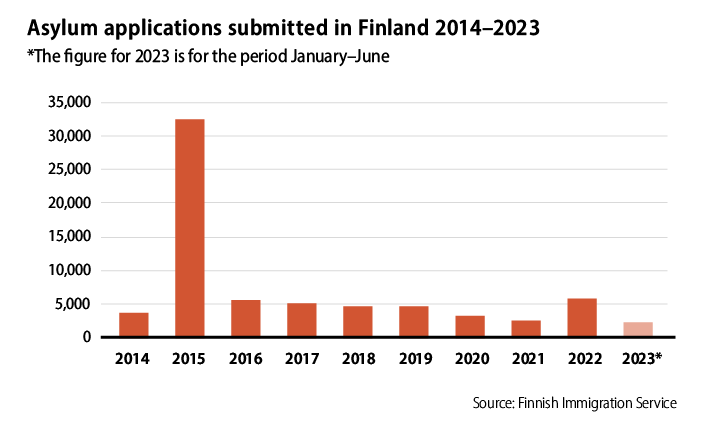
Figure: Asylum applicatios submitted in Finland 2014-2023

So far, the increase in irregular migration to the EU has had a limited impact on Finland or the other Nordic countries.

Figure: Nationalities of asylum seekers in Finland 2023

In 2022, approximately 5,800 people applied for asylum in Finland. The profile of asylum seekers was clearly different from the preceding years. The largest group of asylum seekers were the Ukrainians, who submitted approximately 1,800 applications. A majority of these Ukrainians applied for asylum before the Temporary Protection Directive entered into force, and later submitted an application for temporary protection. Another distinguishing aspect of the year was the increase in the number of asylum applications of Russian citizens especially after the general mobilisation announced in September. In 2022, Russians submitted approximately 1,200 asylum applications, compared to 400–500 applications in previous years. Of all applications, approximately 900 were subsequent applications. 

This year, the number of applications has evened out and there has been a decline especially in the number of asylum applications submitted by Russian citizens. A total of 2,070 applications were submitted between January and June, 449 of which were subsequent applications. Currently, the largest groups of asylum seekers are from Iraq, Somalia and Russia. The factors contributing to the number of asylum seekers include migration pressure to the EU, the situation in the key departure and transit countries, border control at the EU’s external borders, temporary border control at the internal borders of some EU Member States, developments in the situation in Russia and actions of the Russian border officials, and the national immigration and asylum policies outlined by the other Nordic countries and the largest recipient countries (Germany, France, Spain and Italy).

Moderate number of Ukrainians have started to move to municipalities

On 4 March 2022, the European Union implemented the system of temporary protection for the first time. This system allows persons fleeing from Ukraine to receive temporary protection without undergoing the asylum procedure. In Finland, some 60,000 Ukrainians have submitted an application for temporary protection (situation on 25 July 2023). Approximately 13,500 of the applications were submitted this year. At the beginning of the year, the number of applications was on the decline, but began to grow again slightly in May. The increase is largely explained by the applications submitted by Ukrainians who have come to Finland for seasonal work.

At the moment, there are around 41,000 Ukrainians in the Finnish reception system. Around 17,000 Ukrainians have left the system, 4,400 of whom have moved to municipalities. The remaining people have most likely left the country, most of them returning to Ukraine or travelling somewhere else in the EU.

Ukrainians continue to apply for a municipality of residence in moderate numbers. So far, applications of approximately 9,000 persons receiving temporary protection have been approved. As mentioned above, 4,400 Ukrainians whose application has been approved have already moved to their municipalities. Of those who have applied for temporary protection, approximately 35,500 have the right to apply for a municipality of residence and move to their municipalities during 2023.

The temporary protection based on the EU directive is currently in force until 4 March 2024 and will end in March 2025 at the latest. To avoid unnecessary movement between countries and burden on the asylum system, the EU is currently seeking a uniform solution for the continuation of residence permits granted on the basis of temporary protection.

According to the projection published by the Finnish Immigration Service’s foresight network, Ukrainian people will submit an estimated 20,000–30,000 applications for temporary asylum in Finland this year. The estimate will be updated again in August. The number of applicants will be affected by reasons such as the duration and extent of the war, the development of the humanitarian situation in Ukraine, and the overloading of reception capacity elsewhere in Europe, which may lead to Ukrainians moving between EU countries.

Finnish Immigration Service confederations of states immigration migratory movement

SISÄMINISTERIÖ
Inrikesministeriet | Ministry of the Interior

Kirkkokatu 12, Helsinki
PL 26, 00023 Valtioneuvosto
Vaihde 0295 480 171
[email protected]


Tietoa sivustosta
Tietosuoja
Saavutettavuusseloste
Sivukartta
Kysy ja anna palautetta

X (Twitter)
Instagram
LinkedIn
Facebook
YouTube

Hakusivulle
  • Etusivu
  • Vastuualueet
    • Poliisiasiat
      • Hallitusohjelman toimenpiteet poliisin toimialalla
      • Rikollisuus Suomessa
      • Järjestäytynyt rikollisuus
        • Järjestäytyneen rikollisuuden torjunta
      • Terrorismin torjunta
        • Torjuntatoimet Suomessa
      • Väkivaltainen radikalisoituminen
        • Toimenpiteiden seuranta
      • Viharikollisuus
        • Maalittaminen
      • Ihmiskauppa
      • Talousrikollisuus ja harmaa talous
        • Rahanpesun ja terrorismin rahoituksen torjunta
      • Kyberrikollisuus
        • Kyberrikollisuuden torjunta
      • Ampuma-aseet
        • Aselainsäädäntö
      • Rahapelit
      • Rahankeräys
      • Yleinen järjestys ja turvallisuus
      • Vartiointi ja järjestyksenvalvonta
      • Toimijat ja vastuut
        • Poliisin toimivaltuudet
      • Lainsäädäntö
    • Pelastustoimi
      • Hallitusohjelman uudistukset pelastustoimeen ja hätäkeskustoimintaan
      • Pelastustoiminta
        • Meripelastus
        • Vaaratiedote
      • Onnettomuuksien ehkäisy
        • Nuohous
        • Palovaroittimet ja muut paloturvallisuuslaitteet
          • Palovaroitin
          • Vastuu palovaroittimista muuttuu 2026
          • Häkä- ja lämpövaroittimet
          • Alkusammutusvälineet
          • Rakennuksen paloturvallisuuslaitteistot
          • Hätäkeskukseen liitetyt laitteistot
          • Paloturvallisuuslaitteiden valvonta
          • Usein kysytyt kysymykset palovaroittimista
        • Pelastussuunnitelma
        • Paloturvallisuus
      • Varautuminen
        • Kansallinen riskiarvio
        • Väestönsuojelu
        • Väestönsuojat
        • Varautumisopas
      • Kansainvälinen avunanto
        • Kansainvälinen siviilivalmiusyhteistyö
        • Pelastuspalvelumekanismi
      • Hyvinvointialueiden valtakunnalliset tavoitteet
      • Pelastustoimen toimijat ja vastuut
      • Lainsäädäntö
      • Tietoa aluevaltuutetulle
        • Pelastustoimen tehtävät
        • Palveluiden järjestäminen ja ohjaus
        • Pelastustoimen rahoitus hyvinvointialueilla
        • Pelastustoimen henkilöstö
    • Hätäkeskustoiminta
      • Hätäkeskukset
      • Hätäkeskuslaitoksen palvelut
      • Lainsäädäntö
    • Rajaturvallisuus
      • Hallitusohjelman uudistukset rajaturvallisuuteen
      • Rajojen valvonta
      • Meripelastus
      • Ympäristövahinkojen torjunta merialueilla
      • Älykkäät rajat
      • Frontex-yhteistyö
      • Toimijat ja vastuut
      • Lainsäädäntö
    • Maahanmuutto
      • Hallitusohjelman uudistukset maahanmuuttopolitiikkaan
        • Pysyvän oleskeluluvan edellytysten tiukennukset
      • Toimijat ja vastuut
        • Laajamittainen maahantulo ja varautuminen
      • Maahanmuutto- ja turvapaikkapolitiikka
        • Perheenyhdistäminen
      • Turvapaikanhakijat ja pakolaiset
        • Kiintiöpakolaiset
          • Usein kysytyt kysymykset pakolaiskiintiöstä
        • Usein kysytyt kysymykset turvapaikanhakijoista
      • EU:n maahanmuutto- ja turvapaikkajärjestelmä
      • Maasta poistaminen ja poistuminen
        • Vapaaehtoinen paluu ja palauttaminen
        • Takaisinottosopimukset
      • Kansalaisuus
        • Kansalaisuuden saamisen edellytykset ja vaikutukset
        • Ulkosuomalaiset
        • Usein kysytyt kysymykset kansalaisuuden menettämisestä
        • Usein kysytyt kysymykset kaksoiskansalaisuudesta
      • Laittoman maahantulon ja oleskelun torjunta
      • Lainsäädäntö
    • Kansallinen turvallisuus
      • Hallitusohjelman uudistukset kansalliseen turvallisuuteen
      • Mitä on kansallinen turvallisuus?
        • Kriittisen infrastruktuurin suojaaminen
      • Siviilitiedustelu
        • Usein kysytyt kysymykset
      • Hybridiuhat
      • Kyberturvallisuus
      • Lainsäädäntö
    • Siviilikriisinhallinta
      • Suomen tavoitteet
      • Suomalaiset operaatioissa
      • Näin haet siviilikriisinhallintatehtäviin
      • Toimijat ja vastuut
      • Lainsäädäntö
    • Suomen lippu ja vaakuna
      • Liputuspäivät ja -ajat
        • Liputuspäivät 2025
        • Liputuspäiväesitykset
      • Suruliputus
      • Liputus EU-lipulla
      • Lippujen arvojärjestys
      • Tietoa lipusta
        • Lipun historia
      • Vaakuna
      • Lippu ja vaakuna elinkeinotoiminnassa
      • Usein kysytyt kysymykset
      • Lainsäädäntö
      • Liputan-sovellus
  • Ajankohtaista
    • Tiedotteet ja uutiset
      • Vuosiarkisto
    • Kolumnit
    • Avoimet työpaikat
    • Päätökset
    • Uutiskirjeet
    • Tapahtumat
      • Ilmiöpäivät
    • Tilaa ajankohtaisaineistoja
    • Ukraina
      • Materiaaliapu Ukrainaan
        • Laptops for Ukraine
        • Lähetetty siviiliapu
      • Avun tarjoaminen ukrainalaisille
      • Tilapäinen suojelu
      • Ohjeita kunnille
      • Usein kysytyt kysymykset
    • Itärajan tilanne
  • Hankkeet ja lainvalmistelu
    • Siviilitiedustelulainsäädännön uudistaminen
    • Passihanke
    • Rikostorjunnan vahvistaminen
      • Vastauksia biometrisia tietoja koskevasta sääntelystä
    • Rahapelijärjestelmän uudistaminen
      • Usein kysytyt kysymykset
    • Ampumaratahanke
    • Kansalaisuuslain uudistaminen
      • Usein kysytyt kysymykset
    • EU-turvallisuustietojärjestelmien tietojen yhteentoimivuus
    • Turvalliset satelliittiviestintäyhteydet
    • Kaikki sisäministeriön hankkeet
    • Lainsäädäntösuunnitelma
    • Lausuntokierroksella
  • Julkaisut
    • Kertomukset ja selvitykset
  • Ministeriö
    • Tehtävät ja tavoitteet
    • Johto ja organisaatio
      • Sisäministeri
      • Kansliapäällikkö
      • Osastot ja yksiköt
    • Hallinnonala
    • Sisäisen turvallisuuden selonteko
    • Konsernistrategia
    • Toiminta ja talous
      • Suunnittelun ja seurannan asiakirjat
    • EU- ja kansainvälinen yhteistyö
      • EU-valmistelujaostot
      • Suomi ja Nato
    • Laillisuusvalvonta
      • Laillisuusvalvonta hallinnonalan virastoissa
      • Kertomukset
    • Valmiusasiat
    • Tutkimustoiminta
      • Sentimentti-tietotyökalu
      • Strateginen ennakointitoiminta
      • EU:n TKI-hankkeet
    • Rahastot
    • Sisäministeriö työpaikkana
      • Henkilöstö
      • Vastuullisuus ja arvot
      • Henkilöstöedut
      • Palkkaus
      • Hakeminen ministeriöön
      • Harjoittelijaksi ministeriöön
      • Avoimet työpaikat
      • Tutustu sisäministeriöläisten työhön
      • Sisäministeriöläiset maailmalla
      • Virka- ja työehtosopimusasiakirjat
    • Ilmoittajansuojelu
    • Historia
  • Yhteystiedot
    • Asia vireille
    • Tietopyyntö ministeriöön
    • Johdon, osastojen ja yksiköiden yhteystiedot
    • Viestintäyksikön yhteystiedot
    • Palaute
    • Tietosuoja
      • Evästeet verkkosivustolla
    • Saavutettavuusseloste
      • Liputan-sovelluksen saavutettavuusseloste
    • Asiakirjajulkisuuskuvaus